


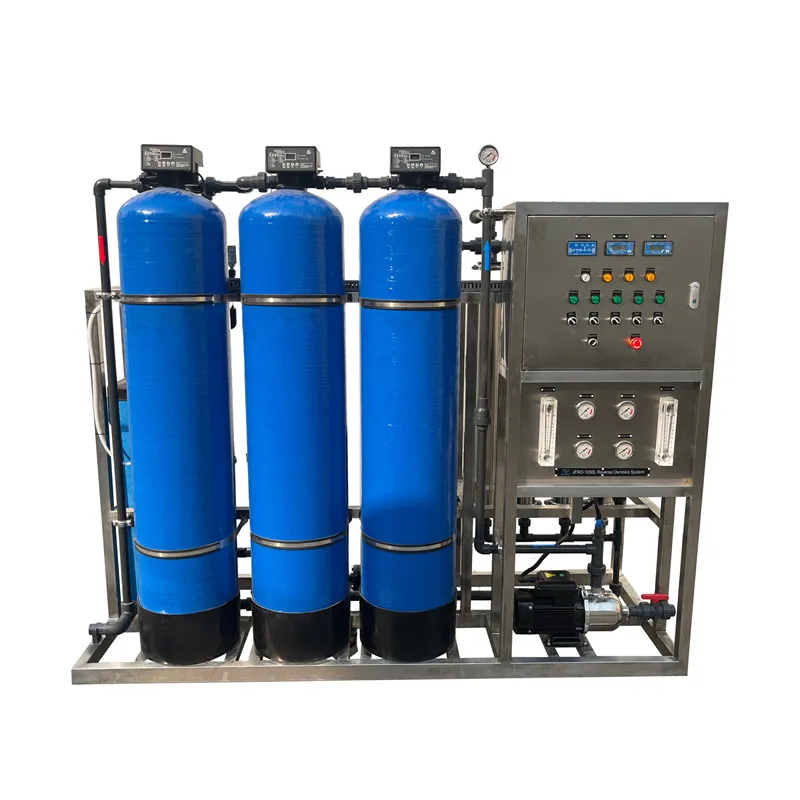
Reverse Osmosis System For Laboratory
Max Water Recovery Rate: 65-70%
Rejection rate: ≥ 97%
Turbidity: 3.0 NTU
Power Supply: 220V, 50Hz
Working Environment: 5ºC – 45ºC
Inlet TDS: <2000 PPM
Booster Pumps: High-Pressure Pump- Multi-Stage
1.5T/H Laboratory Reverse Osmosis System: Ultra-Pure Water for Lab
EDI-Integrated | 99%+ Ion Removal | ASTM Type I/II Compliant
For labs requiring ultra-pure water-whether for PCR, HPLC, or pharmaceutical formulation-our 1.5T/H reverse osmosis system delivers conductivity below 1µS/cm. This system integrates advanced RO and EDI technologies to remove over 99% of dissolved ions, organics, and colloids, ensuring compliance with ASTM Type I/II standards.
Why Our reverse osmosis system for laboratory Stands Out
| Laboratory Water Problems | Technical Solutions | Core Values |
|---|---|---|
| Substandard water purity affects experimental results | ✅ EDI+RO Hybrid Technology | Removes 99%+ dissolved ions (e.g., Na⁺, Cl⁻), achieving <1µS/cm conductivity (ASTM Type I). |
| Frequent maintenance increases labor costs | ✅ Automated Controls & Self-Cleaning | Real-time conductivity monitoring + auto-backwash; reduces manual intervention by 80%. |
| Chemical regeneration is environmentally polluting and costly | ✅ EDI Zero-Chemical Regeneration | Eliminates acid/alkali usage; lowers operational costs by 30% vs. traditional DI systems. |
| Limited space makes it difficult to install large equipment | ✅ Compact, Corrosion-Resistant Design | Stainless steel frame + FRP tanks; fits under laboratory benches (W×D×H: 1200×800×1600mm). |
Technical Specifications
| Parameter | Details | Laboratory Relevance |
|---|---|---|
| Capacity | 1500L/H (1.5T/H) | Supports high-throughput experiments (e.g., 24/7 operation). |
| Conductivity | <1µS/cm (ASTM Type I) | Meets requirements for molecular biology, HPLC, and IC. |
| Process Flow | Quartz sand filter → Carbon filter → Softener → RO → EDI → UV sterilization | Multi-stage purification ensures no residual contaminants. |
| RO Membrane | Vontron 8040 (98% rejection rate) | Industry-leading membrane for stable ion removal. |
| Control System | PLC with touchscreen + auto-alarm | Real-time monitoring of water quality; alerts for membrane replacement. |
| Power | 2.25kW (solar/electric optional) | Energy-efficient; compatible with laboratory power grids. |
EDI: The Heart of Ultra-Pure Water Production
How EDI Works:
Electrodeionization (EDI) uses a DC electric field to drive ions through ion-exchange membranes, removing contaminants without chemical regeneration. Paired with RO, it polishes water to <1µS/cm, critical for sensitive experiments like PCR and mass spectrometry.
Advantages Over Traditional DI Systems:
- No Chemicals: Eliminates acid/alkali handling, reducing lab safety risks.
- Continuous Operation: 24/7 water production without downtime for regeneration.
- Low Maintenance: Only requires periodic membrane cleaning (every 6 months).
Trusted by Leading Laboratories
- Molecular Biology: DNA sequencing, PCR, and cell culture (avoids ion interference in reactions).
- Pharmaceutical Research: Drug formulation and stability testing (complies with USP <1231>).
- Analytical Chemistry: HPLC, IC, and AA spectroscopy (minimizes baseline noise).
- Clinical Diagnostics: Sample preparation for ELISA and immunoassays (ensures accurate results).
FAQ
Q1: How often does the RO membrane need replacement?
A: Typically, every 2-3 years under normal laboratory use (municipal water source).
Q2: Can the system handle hard water (high TDS)?
A: Yes. The integrated water softener reduces hardness to <50 ppm, protecting RO membranes.
Q3: Does it comply with GLP standards?
A: Yes. The system logs conductivity, flow rate, and maintenance records for audit trails.

Hot Tags: reverse osmosis system for laboratory, China reverse osmosis system for laboratory manufacturers, suppliers, factory, 1500 Lph RO Plant, 3000 Lph Ro Plant, 250 LPH Industrial RO Plant
You Might Also Like

Send Inquiry