



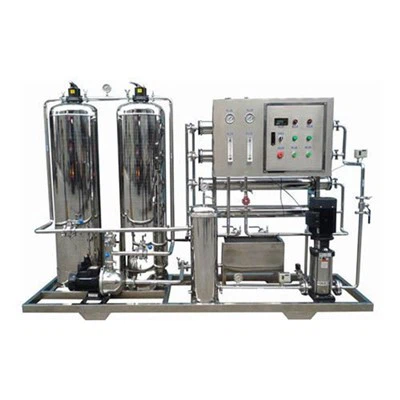
1000 LPH Mineral Water Plant
Duty Cycle:9000 – 10000 L/Day
Max Water Recovery Rate: 60-75%
Power Supply: 220V, 50Hz
Weight: 500 Kg approx
Inlet TDS: <2000 PPM
Booster Pumps: High-Pressure Pump- Multi-Stage
The 1000 LPH Mineral Water Plant is a state-of-the-art reverse osmosis (RO) system designed to transform tap water, well water, or underground sources into safe, high-quality water for drinking, irrigation, or food production. Utilizing advanced semi-permeable membrane technology, this plant effectively removes up to 99% of contaminants, including dissolved salts, heavy metals, organic impurities, bacteria, and colloids, even from sources with TDS levels up to 1000 ppm. Capable of producing 1000 liters of purified water per hour, the water plant ensures consistent output while maintaining low energy consumption, making it ideal for small communities, farms, or food processing facilities.
Engineered for versatility, this RO system addresses challenges like turbidity, radium, and taste/odor issues, delivering crystal-clear water that meets stringent health standards. Its modular design simplifies installation and maintenance, while automatic controls optimize performance with minimal manual intervention. Whether supplying potable water for households, irrigation for agriculture, or process water for bottling lines, the 1000 LPH Mineral Water Plant combines reliability with cost-efficiency.
1000 LPH Mineral Water Plant Specification
|
Item |
Specification |
|
1.Electricity Supply |
220v-440v, 50hz/60hz |
|
2.Membranes Brand |
USA DUPONT, CHINA VONTRON, JAPANESE TORAY |
|
3.Pump Brand |
CNP |
|
4.Motor Brand |
CNP |
|
5.Control |
PC or SIEMENS PLC program control |
|
6.Desalination rate |
More than 97% |
|
7.Recovery rate |
at less 50% |
|
8.Material |
FRP(Fiberglass) with U-PVC, Stainless steel |
Features and advantages of the RO system
- Uninterrupted Operation with Full Automation: Self-regulating controls enable 24/7 water production without manual intervention, which is ideal for high-demand residential or industrial use.
- Chemical-Free Regeneration & User-Friendly Design: Eliminates chemical dependency for filter renewal, reducing environmental impact while simplifying upkeep.
- Smart Level Sensors for Energy Efficiency: Auto-activates when pure water tanks are low and shuts off during raw water overflow, optimizing resource usage.
- Auto-Flush Technology for Membrane Longevity: Automated 90-second rinsing cycles prevent scaling and biofouling, extending membrane lifespan by up to 30%.
- Dual Protection Mechanisms: Safeguards pumps against dry runs and low-pressure damage, ensuring equipment durability in variable supply conditions.
- Real-Time Water Quality Analytics: Integrated conductivity meters provide continuous TDS monitoring, with digital displays for instant purity verification.
- Comprehensive Monitoring Instruments: Includes flow meters, pressure gauges, and solenoid valves for precise system diagnostics and performance tuning.
- Centralized Control Hub: An intuitive RO controller manages all operations-from filtration to flushing-ensuring seamless automation.
- Streamlined Maintenance & Intuitive Controls: Modular components and accessible interfaces minimize technical expertise requirements for troubleshooting.
How do I get a 1000 lph mineral water plant cost?
To receive an accurate quotation, we typically require the following details:
1. Source Water Quality & Type
Specify the raw water source: tap water, well water, underground water, or seawater.
Provide a water analysis report (TDS, conductivity, pH, hardness, contaminants) to determine pretreatment needs.
Example: High-TDS groundwater may require additional reverse osmosis (RO) stages, increasing costs.
2. Required Capacity & Output Specifications
Confirm the desired production capacity (e.g., 1000 liters per hour).
Clarify operating hours (continuous vs. intermittent use) to size tanks and pumps appropriately.
3. Application of Purified Water
Define the end use: drinking water, bottled mineral water, food/beverage production, or industrial processes.
Example: Bottling plants need ozone/UV sterilization and mineralization units, while industrial uses may prioritize cost-efficiency over taste.
Why These Details Matter?
- Source Water: Seawater desalination systems cost significantly more than tap water treatment due to high-salinity pretreatment.
- Capacity: A 1000 LPH system for 24/7 operation requires larger storage tanks and robust components vs. intermittent use.
- Application: Medical-grade water demands stricter certifications (e.g., USP, WHO) and advanced polishing filters, impacting pricing.
By sharing these specifics, we can tailor the system (RO membranes, pumps, sterilization) and provide a transparent quote.

Hot Tags: 1000 lph mineral water plant, China 1000 lph mineral water plant manufacturers, suppliers, factory, 1500 Lph RO Plant, high quality ro system, 6000 Lph RO Plant, efficient ro water treatment, commercial ro water treatment, residential ro water treatment
Previous
1500 GPD Reverse Osmosis SystemYou Might Also Like


Send Inquiry